

.jpg)
The Legacy of Jim Hartung
By the CGA Staff Writing team
WHO WAS JIM HARTUNG?
If you ask the internet this question, you will see that Hartung was a legendary American male gymnast. He was a two-time Olympian and helped the U.S. men’s team win its first-ever gold medal in 1984. He was a standout at the University of Nebraska, securing 22 All-American Awards, the Nissen-Emery Award and was a seven-time NCAA event champion. He led the Huskers to their first four NCAA team titles and finished his collegiate career as the most highly decorated gymnast in Nebraska history; he still owns the program's all-around record. He was a visitation coach for the U.S. national team and was a top-10 judge. He was inducted into three Hall of Fames: Nebraska Athletics, World Acrobatics Society and the College Gymnastics Association. And for the past twenty years, Hartung was the assistant coach at the University of Nebraska, helping the program produce many All-Americans and return to the national stage.

But when Hartung passed away on January 10, 2026, at the age of 65 from a heart attack, his accolades were far from being the topic of conversation. Instead, people talked about his legacy, the type of person Hartung was, what he gave to the Olympic team, the 1979-1982 Nebraska teams, the 2006-2026 Nebraska teams and especially to the sport of men’s gymnastics.
MORE THAN A COACH
When Nebraska gymnasts walk into the gym for the first day of practice, they are split into groups and designated a coach. In 2006, first-year gymnast John Robinson was put in Hartung’s inaugural group. Even though Hartung was Robinson’s coach, he quickly became more.
“In a lot of ways, he’s kind of a father-figure to a lot of his athletes,” Robinson said. “Every one of us loves him, and he is family. That’s what he meant to every one of his athletes.”

Hartung cared more about his athletes as people than as gymnasts. He would spend time outside of the gym with his athletes, connecting with them by fishing, playing card games, watching football and having long conversations after practice. Gymnastics was just a vehicle to reach the person for Hartung.
“He was more than just a coach outside of the gym; he’s just a really good buddy,” former Husker great Taylor Christopulos said. “Whenever you'd see him, it was just like seeing an old friend.”
There are countless stories from athletes about interacting with Hartung outside the gym. He would bring Nebraska senior Luke James the golf balls he found in the grass on his walks because he knew James enjoyed playing golf. Another time, he promised the guys a surprise if they did well in the gym. So the team did great on their assignments, and he had the guys go up to his office. He pulled out mint chocolate chip ice cream and juneberry Red Bulls, made them floats and had a little team party in his office.
“He was really excited to show us his invention,” James said. “So we all acted as if it were the greatest thing since sliced bread. That’s definitely a memory that’s gonna stick with me.”
For Robinson, the long talks he had with Hartung are moments that will stick with him forever. Robinson was often injured as an athlete, and during those tough times, he grew closer to Hartung and leaned on him through it all.
“In a lot of ways, he gave me the gift of belief each time I got injured,” Robinson said.
In 2010, Robinson graduated from the University of Nebraska. He was in Hartung’s group all four years and left the program a man, in large part because of Hartung.
“He was that lighthouse for so many of us,” Robinson said. “He showed us the way, taught us how to be men, how to be respectful, good people, good contributors to the world and students of the sport.”
DAD
Outside of the gym, Hartung was a family man. His favorite way to bring everyone together was to fire up the grill and cook a steak or crab dinner. Hartung had four kids: Jim, Nick, Jake and Hannah, and he loved teaching them things he was curious about. He would take the boys to the shooting range, coached them in gymnastics and even spent countless hours with Jake working on his house.
Hartung loved traveling for something that mattered, like a gymnastics meet or a hunting or fishing trip. He would bring his boat from Nebraska all the way up to Lake Owen Gymnastics Camp in Wisconsin, and would take out the boys and their friends in between gym sessions. He would show them how to tie fishing knots while telling stories about days when he caught a ton of fish. Lake Owen, in particular, had everything he loved: family, gymnastics, old friends, fishing and the outdoors.
“While Lake Owen is just one memory, it really captures who he was,” Jake said.

Hartung used the same coaching instincts in his role as a dad. If something mattered to him, he took the time to understand it and pass it on. He introduced his kids to lots of new things, and if there was ever something they really wanted to focus on, he would put his time and energy into helping them figure it out.
“Looking back now, I think he approached parenting the same way [as coaching],” Jake said. “He didn’t treat all of us exactly the same. He adjusted, paid attention and got better at it over time.”
In many ways, Hartung treated Robinson like his own. Because of this, Robinson has a unique bond with the Hartung’s kids.
“It was so much fun going into the gym with him when I was little and meeting his athletes,” Jake said. “They could never say enough good things about my dad. At the time, it all felt normal to have everyone think your dad is amazing. But as I grew up and began to understand what the real world can be like, I realized just how lucky I was to be his son.”
For Robinson, it’s been special to witness his kids have unique and special relationships with his athletes; he’s getting a whole other perspective of how Hartung viewed him all those years ago.
When Robinson’s kids run into the gym and give the guys knuckles, he gets flashbacks to when Hartung’s kids would come into the gym and do the same thing.
“I feel like I’m kind of reliving that,” Robinson said. “I get to experience what Jim experienced, and my kids are experiencing what Jim’s kids experienced. That’s a pretty special thing.”
WRITER
What many people don’t know is that Hartung couldn’t speak. After battling throat cancer in 2006, Hartung lost his voice. He would coach and communicate by writing, and both he and his athletes had to learn to be patient.
“It shows a lot about the kind of person that Jim was,” Christopulos said. “It’s a testament to who he was. How patient he was, how willing he was to work with you in just taking the time to write down what he wanted to say.”
And Hartung wouldn’t just write down notes; it was always a novel.
“Every one of us probably has a sheet of paper with his handwriting with some message,” Robinson said. “And it is something we will never get rid of.”
Christopulos actually had some notes from Hartung hanging up in his locker. One was during the fall of his junior year. The team was ramping up for the season and was doing weight training in the morning and then practice in the evening. Christopulos’ body was beaten down, but he still fought to stay on for his pommel horse routine. Hartung had grabbed a coupon because he didn’t have a piece of paper and wrote on the back of it. He told Christopulos that he was back to where he needed to be, which gave him the confidence and reassurance that he was on the right track.
“Hearing something like that from a legend really boosts your confidence,” Christopulos said. “He put me in a spot to allow me to choose to take that next step.”
James also has several of Hartung’s notes hung up in his locker. One note in particular, James can quote from memory and lives by. It says, “A very wise Nebraska coach once said, ‘If you're not the lead dog, the scenery never changes.’”
James also kept a long essay Hartung wrote before he competed at the World Championships.
“He told me it was going to be a privilege to compete against the best in the world,” James said. “But I shouldn't look at it in that view. I should rather look at it like I belong there and I deserve to be there, and I am amongst the best in the world because I am.”
COACH
After winning gold at the 1984 Olympics, Hartung decided to give back to the sport in the form of coaching. He was a visitation coach for the U.S. national team before returning home to coach at his alma mater for 20 years.
“Some of the best coaching experiences I remember were when I had the privilege to coach with Jim,” Tim Erwin wrote in a comment on a Facebook post.
Hartung’s coaching style was unique and powerful. He understood both the athlete and coaching aspects of the sport, and he had a certain amount of playfulness that made his gymnasts as competitive as he was. He was a master at making training enjoyable and comfortable, even making the hard days fun and easier.

“He'd always come to the gym with an iPad watching social media,” Christopulos recalled. “Or he'd always come in with his Shields or Cabela's magazine and flip through it. He just kept it really casual. Even on the most stressful days, he had a way of making me feel calm.”
Hartung had the rare gift of making his athletes have faith and focus on the right things to reach their goals. No matter how small or how outlandish it was, there was a strong level of belief that when he was in your corner, you could obtain anything you were trying to shoot for.
“I think that was one of his gifts in life was just to make people feel like they were the best person in the world,” Christopulos said. “It doesn't matter how good you are at gymnastics; he just had the ability to motivate you and make you feel like you were an Olympic gold medalist.”
For James, who struggled with some confidence issues in the gym, Hartung’s “no doubt mentality” was valuable to be around. One of his favorite sayings was, “You do not get on the apparatus if you’re doubting anything. You have to get up with the intention of being perfect every single time.”
One of the things that made his coaching special was how he taught. He helped his athletes face the challenges of gymnastics by going beyond technique, though he was a big proponent of doing technical basics before actual training, and he often explained things through a story from his own life. During a car ride home from practice, he told Jake about the time he was doing a routine on the parallel bars and jammed, maybe even dislocated, his finger on a Stutz. But that didn’t stop him, and he finished the routine.
“He would grind through the hardest moments, whether it was fear or pain,” Jake said. “And the point in all of that was that you control your own destiny. He used to say, ‘There were two people: one who said they could and one who said they couldn’t, and they were both right.’ He didn’t make that up, but he sure said it a lot, and he lived by it.”
Like Hartung, Robinson decided to coach at Nebraska after competing. Robinson has been an assistant coach for 16 years and has picked up a lot of Hartung’s coaching style, including his eye for judging.
“The majority of who I am as a coach is Hartung,” Robinson says.
LEGACY
It was senior night at Eastern Michigan, and Hannah was up next on bars. Despite the nerves, she hit the routine, and when she looked up, she saw her father. He didn’t attend many competitions because of his coaching responsibilities at Nebraska, but he made sure to be there for her that night.
“I looked up at him, and he was so proud,” Hannah said, becoming emotional. “He was really proud, no matter what that looked like, so yeah, that’s a memory I’ll never forget.”
And now Hannah is following Hartung’s career path. From competing in college at Eastern Michigan to coaching at Bowling Green and now pursuing judging, Hannah is hoping to impact and leave impressions on her athletes the same way her father did.
“He was so good at what he did,” Hannah said. “Being able to communicate with the athletes and build that respect and have an impact takes a lot of time, and I hope I can do the same thing with whatever I do.”

When Hartung competed in the early 80’s, men’s gymnastics was extremely popular, and there were 79 NCAA men’s gymnastics programs. Throughout the years, he had to watch many of them fall, but he also watched as Robinson worked to bring online the two new NCAA men’s gymnastics programs, Greenville and Simpson College, in 2022.
“He wrote me a long, heartfelt message about how proud he was of the impact I was making on the sport,” Robinson said. “Not just growing it but sustaining it.”

In many ways, Hartung was passing the torch to Robinson; he gave Robinson every bit of knowledge and heart he possibly could. He taught Robinson and all of his other gymnasts how to be a true Husker: to be loyal, honest and true to the work being put in while also being friendly and enjoying the process. Hartung’s ways bled into the gym, the mats and the walls, and his footsteps will be there forever.
And now, Robinson’s goal is to continue his lasting legacy.
“I want to make sure that everyone knows who Jim Hartung was, as a person and as a coach,” Robinson said. “My goal is to make sure that all of Nebraska, from here on out, every Nebraska athlete, whether they know it or not, was coached by Jim through somebody else or some other way. His lessons are going to continue. His philosophies, his approaches, all of those things are going to continue to a point where every Husker gymnast from now until the end of time is going to be coached by Hartung.”
And the process has already started.
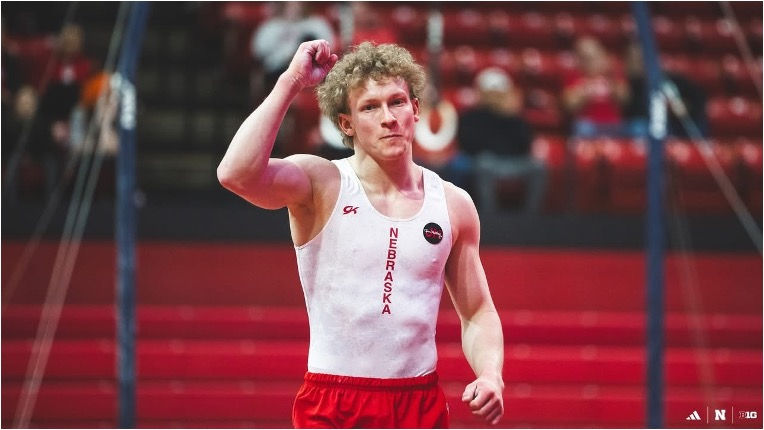
On Saturday, February 7, the team honored Hartung by providing a dedication poster to fans and debuted Jim Hartung patches on the left side of their uniforms, right over their hearts, in their win against Penn State.
“When I was putting on my uniform, probably 20 minutes before I put my hand up, it was definitely a heart-sinking moment,” James said. “But when I stepped out there, and I was in the arena, with the patch over my heart, that gave me security and reminded me that I could attack my gymnastics as if Jimbo was there in the corner as he used to be.”
The Hartung Award, which was first awarded in 1987, will continue to stand as the honor every Husker gymnast strives to achieve. Additionally, thanks to generous donations to the Nebraska program, there will now be a Jim Hartung Memorial Scholarship.
WHO WAS JIM HARTUNG?
So who was Jim Hartung?
He was a gymnast and competitor. He was a coach. He was a judge. He was a hunter, fisher, gardener and fixer. He was curious and did things his way. He was knowledgeable and an expert. He was a believer. He was gracious and kind. He was a mentor and role model. He was a father not just to his own children but to the countless young men who were fortunate enough to be trained by him. He was a brother. He was a listener. He was a writer, storyteller and humorist. He was a lighthouse. He was a friend and a buddy. He was a hero. He was a leader. He is forever imprinted into the souls of those he touched.
Hartung’s legacy lives through every person he spoke to and interacted with. Hartung had the special quality to connect with people on a very deep level, and he had this amazing ability to bring the most out of everyone he interacted with. His awards and records will never fade, but where Jim's legacy will spread the furthest is through the enormous number of people that he's helped, touched and been around.


Ku bet tối qua mình lướt trong lúc nghỉ tay, kiểu mở ra xem cho vui thôi mà thấy trang này sắp xếp thông tin khá dễ chịu, cuộn xuống là gặp từng khối nội dung rõ ràng nên mắt không bị mỏi. Mình không đọc kỹ từng đoạn đâu. Chỉ để ý họ nói kho game hơn 150 trò nên nhìn cũng “có cái để nghịch” nếu ai rảnh. Menu với các mục được nhóm theo sảnh nên tìm nhanh. Chữ trên tiêu đề to vừa, dễ bắt nhịp. Kéo xuống vẫn giữ bố cục theo cụm, không bị dồn chữ. Nói chung cảm giác dùng như đang xem một trang được chia block gọn gàng, nhất là phần…
Si può vedere che le interpretazioni evitano eccessi e rimangono fondate. Il ragionamento non supera i dati di supporto. Il sito Web include dettagli contestuali ampliati sulla questione. La portata dell'analisi è ampliata dagli ecosistemi di intrattenimento online.